Idle Bank Tycoon: Money Empire
- 4.6
- Rating
- 10.00M
- Installs
- Free
- Price

 Analysis by App-foxy
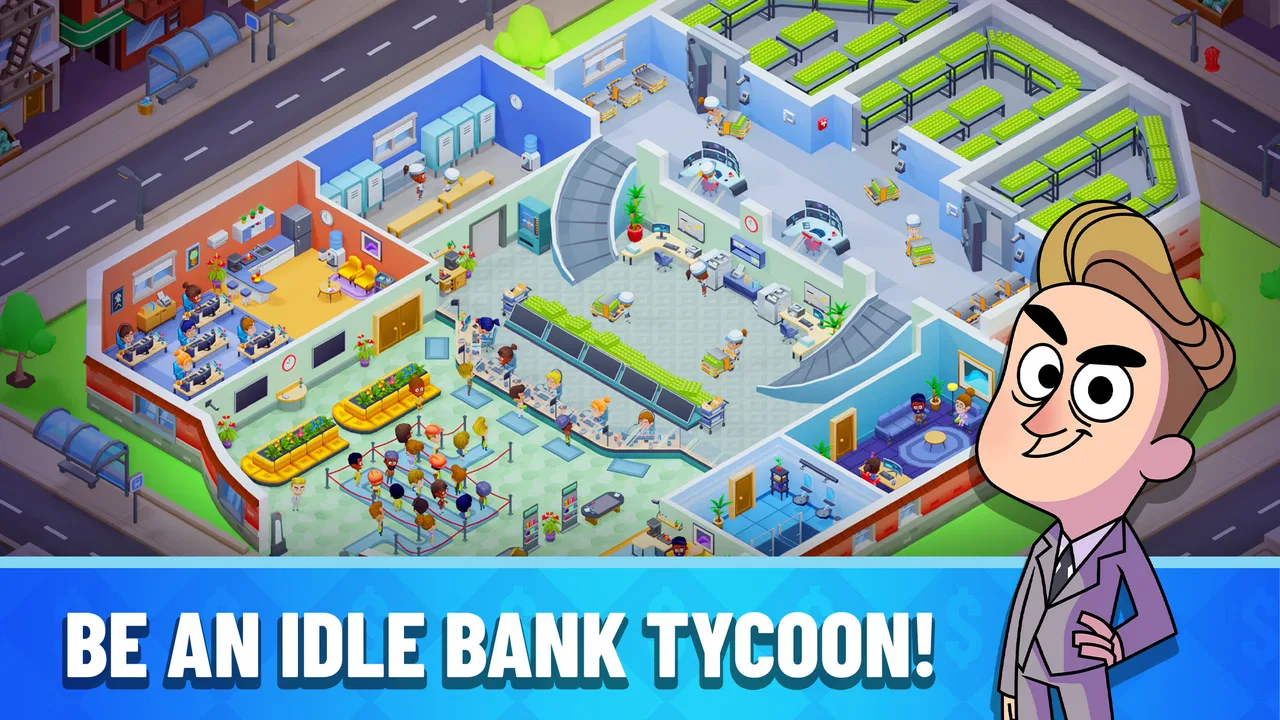
I approached Idle Bank Tycoon: Money Empire as a short-session simulation game rather than a traditional strategy title. Its central appeal is easy to understand: you build up a bank, improve its earning potential, and return later to see how far your progress has moved. That makes it a natural fit for people who enjoy gradual upgrades without needing to control every second of play.
My experience was most enjoyable when I treated it as a background game. I could make a few decisions, leave it alone, and come back when I had enough progress to improve the next part of the bank. It is not the right choice if you want a detailed financial simulator or a competitive management game with deep economic modeling. It is a lighter, more accessible idle simulation game built around momentum and repetition.
Kolibri Games has kept the presentation approachable, which matters for a game designed to be opened frequently. The store classifies it as a simulation game, it is free to install, and its Everyone age rating makes it broadly accessible. The current version is 1.82.1, and the game runs on Android 7.0 or later. Those details make it relatively easy to try, but the real question is whether its slow, upgrade-focused rhythm suits the way you like to play.
You May Also Like

 Blood Strike: 2.5 Anniversary
Blood Strike’s Loadouts Turn Every Drop Into a Tactical Gamble
A close look at Blood Strike’s custom loadouts: how fast access to signature weapons reshapes its battle royale rhythm, rewards preparation, and narrows the gap between fights.

 Pandora - Music & Podcasts
Pandora’s Music Is Easy to Start, but Harder to Recover
Pandora’s strength is its low-effort path from a seed to a station. Its weak spot is how much confidence it asks you to place in connection, setup, and quiet recovery.

 8 Ball Pool
 Is Built on Rivalries, Rematches, and Routine
A close look at the rivalries, rematches, shared routines, and unanswered safety questions that turn a quick pool match into a persistent mobile community.

 Samsung Music
’s Quiet Strength Is Playing What You Already Own
Its reach comes less from spectacle than from dependable access to a personal library. That simplicity is both the app’s strongest retention engine and its ceiling.

 AccuWeather: Weather Radar
AccuWeather Review: A Quick, Clear Forecast for Everyday Decisions
For everyday plans, the best forecast is the one you can understand quickly. AccuWeather makes rain timing, radar, and local conditions easy to act on, with a few trade-offs.

 Hill Climb Racing
Why Hill Climb Racing Still Turns Crashes Into One More Run
A tiny car, a bumpy hill and one more upgrade: Hill Climb Racing keeps resurfacing because its simple chaos makes every near-miss feel personal.
More From Our News Desk



Where players are most likely to get stuck
I’d use this section to focus on the point where the game’s easy opening gives way to more deliberate upgrade choices. When progress feels slow, I’d first compare the available improvements and decide what will best support the next stretch, rather than buying simply because an option is ready.
The first minutes explain the idea, not the best long-term routine
The opening is straightforward, but that simplicity can hide an important distinction: not every available improvement has the same value at every moment. Early on, it is tempting to spend every available amount immediately because seeing the bank improve feels rewarding. I found it more useful to pause briefly and consider whether the next purchase would increase regular income, remove a bottleneck, or simply make one small area look better.
That choice matters because idle games reward repeated decisions rather than one dramatic action. If you spend without looking at the broader flow, you can end up waiting longer for the next meaningful upgrade. The game does not require complicated calculations, but it does reward a little patience. My practical rule was to compare the cost of an improvement with the time I expected to keep the game running before checking again.
Offline progress can create the wrong expectation
The phrase “idle” naturally suggests that the game will do everything while you are away. In practice, I would not treat it as a completely hands-off experience. Returning to collect progress is part of the loop, and the most satisfying results come from checking in, choosing an upgrade, and setting up the next stretch of growth.
This is one of the first places where a new player may think something has gone wrong. If the bank seems to have advanced less than expected, first look at the active progression screen and the available upgrades before assuming the game has failed. Idle progress is usually more satisfying when viewed as a limited return for time away, not as a replacement for every decision.
Small rewards can distract from the main economy
Games in this style often present several things to tap, claim, or improve, and this one can encourage the same habit. My advice is to identify the upgrade that strengthens the bank’s ordinary earning loop before chasing every short-term reward. A quick bonus may feel useful, but a permanent improvement can be more important when you plan to keep playing for several sessions.
This is also where the game may feel repetitive to players who want constant novelty. The satisfaction comes from watching numbers and facilities develop, not from discovering a new kind of challenge every few minutes. If you need frequent surprises, a conventional tycoon game with missions, characters, or a more active map may hold your attention better.
In-app purchases change the patience test
The game is free to play, but optional purchases range from $0.99 to $74.99 per item. That is worth keeping in mind before you start treating every upgrade as something that should happen immediately. The natural pressure in an idle game is to shorten waiting, and spending can make that temptation stronger.
I recommend deciding your boundary before playing. If you are comfortable progressing slowly, the free structure is easier to appreciate. If you dislike seeing paid options while waiting for growth, the experience may feel more commercial than relaxing. The higher-priced items are especially important to consider because they can turn a casual experiment into a larger purchase unless you pay attention.
Why the game can appear to stop moving
When progress seems frozen, I would check the obvious in-game causes first: whether an upgrade is waiting, whether a reward still needs attention, and whether the current objective has changed. A game built around upgrades can look inactive when it is actually waiting for the player to make the next economic choice.
After that, I would close and reopen the game, check that the device has a stable connection when one is needed, and make sure the application is updated. These are ordinary recovery steps, but they are useful because they separate a temporary loading problem from a design moment where the game simply expects another decision.
Setup checks and a smoother way to play
Here I’d cover a few low-risk checks that can make returning to the game less frustrating, from giving a slow launch time to settle to avoiding disruptive troubleshooting too early. I’d also suggest setting a purchase boundary before playing, so the game’s gradual pace stays comfortable rather than turning every wait into pressure to spend.
Before blaming the game, check the basic conditions
On Android, the minimum requirement is version 7.0. That is a modest requirement, but meeting it does not guarantee identical performance on every phone. Available storage, background activity, battery-saving settings, and the age of the device can all affect how quickly a game opens or resumes.
I would begin with a simple setup: install it on a device with some free space, use a reliable connection during installation and updates, and avoid launching it while the phone is already struggling with many demanding applications. If the game opens slowly, closing unused apps and restarting the phone is a more sensible first step than repeatedly tapping the screen.
It is also useful to distinguish installation from gameplay. A successful installation does not prove that every later session will load perfectly, while a slow first launch does not automatically mean the game is incompatible. Give it a moment, then try a clean restart. This approach avoids making the problem worse through repeated force-closing during a loading process.
Use the first session to learn the rhythm
I would not rush through the opening simply to reach a larger bank. The first session is the best time to learn what the game considers valuable. Watch how quickly ordinary earnings build, notice which improvements affect the next decision, and see how often you are expected to return.
A useful routine is to play in short blocks. Open the game, review the bank’s current state, choose one or two improvements, collect what is ready, and leave. This gives you a clearer sense of progress than constantly reopening the game every few minutes. It also protects the game’s main strength: letting it fit around your day rather than demanding your full attention.
Plan upgrades around your next visit
One of the more practical ways to enjoy the game is to make each session end with a plan. Instead of spending everything automatically, decide what you want to afford next and leave the game with that target in mind. When you return, you can immediately evaluate whether the target is still the best use of your earnings.
This creates a small but meaningful management loop. You are not merely collecting money; you are preparing the next stage of the bank’s growth. It also reduces the feeling that the game is just a sequence of identical taps. The decision may be simple, but having a reason for it makes the idle waiting feel more purposeful.
A realistic everyday scenario
For me, the most believable use case is a person who has a few spare minutes during a commute, lunch break, or while waiting for an appointment. They open the game, collect accumulated progress, make a sensible improvement, and close it again. Later, they return to see whether the decision produced a better result.
That routine works because the game does not need to become the center of the day. It can sit alongside a podcast, a work break, or a longer game that requires more concentration. The trade-off is that the experience may feel too passive during a long uninterrupted session. I would recommend it for frequent short visits, not for an evening when you want hours of active challenge.
What to do if a session does not restore properly
If your progress appears different after reopening, avoid immediately uninstalling the game. First restart the application normally and check whether the display catches up. If the issue continues, restart the device and confirm that you are using the same account or device environment as before, where applicable.
I would also avoid clearing application data casually. That kind of step can remove local information, and it is not a sensible first response to a single bad session. Keep troubleshooting conservative: restart, update, check the connection, and only then consider more disruptive actions. If a problem remains, the safest next step is to use the game’s own support route rather than experimenting with files or unofficial tools.
When the app is not the cause
Not every delay comes from the game itself. A phone operating under aggressive battery restrictions may limit background activity. A nearly full storage drive can make updates and temporary files harder to handle. A weak connection can affect loading even when other applications appear to work normally.
There is also a human cause: expectations. If you return after a short absence expecting a major transformation, the game may seem unresponsive even though it is progressing at its intended pace. Idle games are built around accumulation, and the reward is often more noticeable across several visits than within one brief check.
Notifications and distractions can create another false impression. If you open the game but leave before reviewing the available improvements, you may miss the decision that unlocks the next stretch of progress. I found that a deliberate thirty-second review was more useful than repeatedly opening and closing it without a plan.
How it compares with other simulation choices
Compared with a hands-on tycoon game, this one asks for less constant supervision. A traditional management game may let you control layouts, staffing, prices, or customer behavior in much finer detail. That can be more satisfying if you want to feel responsible for every operational choice, but it can also become demanding.
Compared with a pure clicker, the bank theme gives the progress a clearer setting. You are not simply watching an abstract counter rise; the idea of building a financial empire provides a reason for the upgrades. Still, players who want a story, a large cast, or complex economic consequences may find the bank framework too light.
The best alternative depends on what bothers you. Choose a more active simulation if waiting feels dull. Choose a deeper management game if you want meaningful failure and long-term planning. Choose a simpler clicker if you want almost no decisions. This title sits between those options, offering more direction than a bare counter while keeping the workload low.
Who should play and who should skip it
I think it is a good match for players who enjoy visible progress, short sessions, and upgrade decisions that remain easy to understand. It is especially suitable if you like checking a game several times during the day and do not mind that the most important reward arrives gradually.
I would be cautious about recommending it to anyone who dislikes waiting, paid acceleration, or repeated upgrade cycles. It is also a weak fit for someone looking for a realistic banking experience. The theme is a playful frame for idle progression, not a lesson in finance or a detailed simulation of how a real bank operates.
The Everyone rating makes it broadly approachable, but age suitability does not tell you whether the monetization style will feel comfortable. Parents and younger players may still benefit from setting purchase controls on the device, particularly because the available items extend from small purchases to much more expensive ones. That is a practical safeguard, not a criticism of the game’s basic concept.
My practical verdict
The strongest way to play is to treat the bank as a scheduled check-in, not a full-time task. Make a few deliberate upgrades, leave it alone, and return when there is enough progress to make the next choice meaningful. That approach keeps the experience calm and prevents the waiting loop from becoming frustrating.
The game has clearly found an audience: it has an average rating of 4.6 from around 695 thousand ratings, with over 10 million installs. Those figures indicate broad interest, although they do not remove the personal trade-offs. A popular idle game can still be the wrong fit if you want constant interaction or dislike optional purchases.
My final opinion is positive but specific. I would recommend Idle Bank Tycoon: Money Empire to a friend who wants a friendly simulation game for spare moments, understands that progress is intentionally gradual, and can ignore the urge to buy every shortcut. I would point a more demanding strategy player elsewhere. Its value comes from simple decisions, a clear sense of accumulation, and the convenience of returning whenever you have a moment—not from deep banking realism or nonstop action.
As a free game from Kolibri Games, it is easy to try without committing money at the start. Just set expectations properly, keep your troubleshooting sensible, and judge it after several short sessions rather than one impatient opening. If the rhythm of collecting, upgrading, and waiting feels satisfying, it can become a pleasant background habit. If that rhythm feels empty, no amount of empire-building language will make it a deeper simulation than it is.
FAQs for Idle Bank Tycoon: Money Empire
01What is the main objective of Idle Bank Tycoon: Money Empire?
Idle Bank Tycoon: Money Empire is a simulation game where you manage and expand your own banking empire. The primary goal is to grow your bank by making smart investments, managing resources efficiently, and unlocking new financial opportunities. As you progress, you can automate processes to increase your profits even when you're offline.
02Is Idle Bank Tycoon: Money Empire free to play?
Yes, Idle Bank Tycoon: Money Empire is free to download and play on both Android and iOS platforms. However, it offers in-app purchases for players who want to accelerate their progress or access exclusive features. These purchases are optional and not required to enjoy the full game experience.
03How do I progress faster in the game?
To progress faster in Idle Bank Tycoon: Money Empire, focus on upgrading your bank facilities and automating processes. Make strategic investments and complete missions to earn rewards. Regularly check back to collect earnings, and consider using in-game boosters or microtransactions if you wish to advance more quickly.
04Can I play Idle Bank Tycoon: Money Empire offline?
Yes, Idle Bank Tycoon: Money Empire supports offline play, allowing you to continue managing your bank and accumulating profits without an internet connection. However, some features, such as leaderboards and certain updates, may require an online connection to access.
05What types of challenges or missions are available in the game?
Idle Bank Tycoon: Money Empire offers a variety of challenges and missions designed to test your strategic thinking and management skills. These can include reaching certain profit milestones, expanding your bank to new locations, and completing special events. Successfully completing these tasks will yield valuable rewards and bonuses.
Pros
- Engaging gameplay with incremental rewards.
- User-friendly interface and easy navigation.
- Frequent updates with new content.
- Offline play available for convenience.
- No intrusive ads disrupting gameplay.
Cons
- Progress can feel slow without in-app purchases.
- Limited tutorial for new players.
- Graphics are simplistic and repetitive.
- Some features locked behind paywalls.
- Requires constant internet for updates.

Idle Bank Tycoon: Money Empire
Gallery